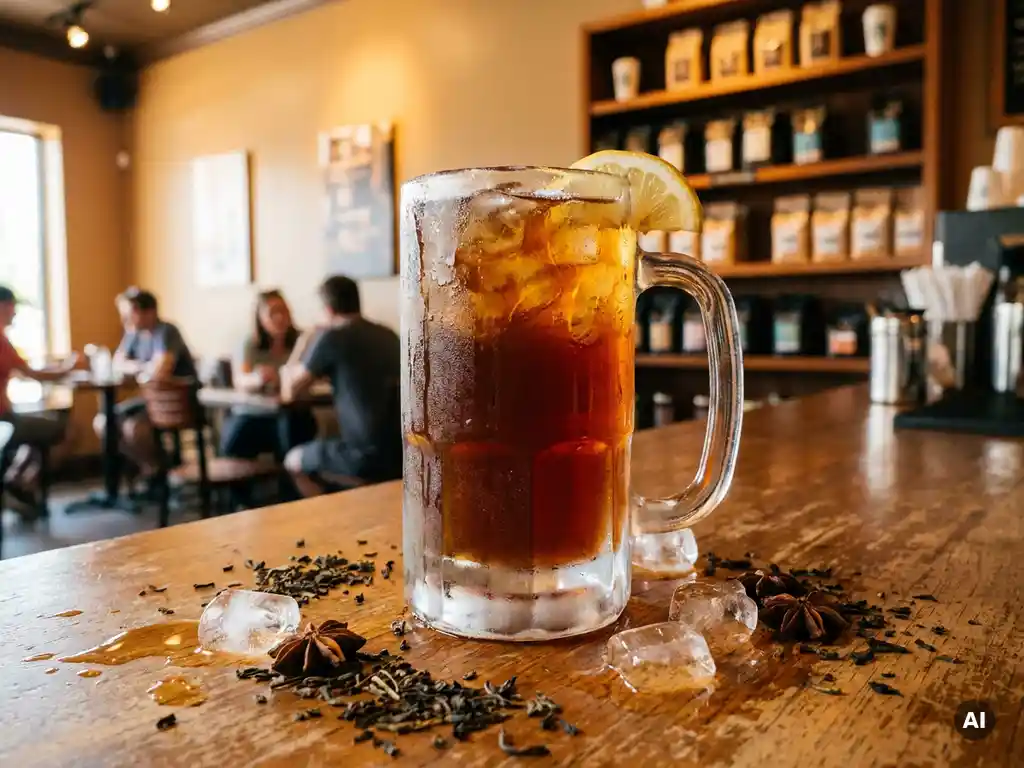
Beer mug iced tea differs from regular iced tea primarily through serving size, ice volume, and the drinking experience those factors create. A standard glass holds 12 to 16 ounces, while a beer mug typically holds 20 to 32 ounces, which changes how the tea dilutes, stays cold, and delivers flavor over time. The sections below break down exactly how each variable shapes the experience.
What makes a beer mug the right vessel for iced tea?
A beer mug is well suited for iced tea because its thick glass walls insulate the drink, its wide mouth accommodates generous ice packing, and its large capacity allows the tea to stay cold and flavorful for longer without immediate dilution. The sturdy handle also keeps warm hands away from the glass, preserving temperature throughout the drink.
Beyond insulation, the shape of a beer mug encourages a slower, more deliberate drinking pace. The heft of the vessel signals that this is not a quick sip but a proper serving meant to be enjoyed over time. For iced tea specifically, that matters because the flavor profile of a well-brewed tea evolves as the ice gradually melts and the liquid temperature shifts. A beer mug gives that process room to unfold rather than rushing it.
The wide base also provides stability, which is a practical advantage when you are loading the mug with crushed or cubed ice before pouring. Many coffee shops and tea bars that serve oversized iced tea use beer mugs precisely because they can pack in a substantial ice bed that chills the tea instantly on contact without cracking the glass, thanks to the thick walls.
How does serving size affect the flavor of iced tea?
Serving size directly affects iced tea flavor because a larger volume of liquid dilutes more slowly as ice melts, maintaining a stronger, more consistent taste throughout the drink. In a small glass, ice makes up a proportionally larger share of the total volume, so dilution happens faster and the tea becomes noticeably weaker within minutes.
With a large iced tea served in a beer mug, the ratio of tea to ice is more favorable. Even as the ice melts, the sheer volume of brewed tea means the flavor concentration stays relatively stable for a longer window. This is why large iced tea servings often taste bolder and more satisfying from the first sip to the last, compared to a standard glass where the final third of the drink can taste thin and watery.
There is also a psychological dimension. A larger serving encourages slower drinking, which means the tea spends more time at a cold but not freezing temperature. That range, roughly between 35 and 45 degrees Fahrenheit, is where many tea varieties express their flavor most clearly. Drinking too fast from a small glass means you consume the tea while it is still intensely cold, which can mute subtler flavor notes.
What’s the difference between beer mug iced tea and regular iced tea in terms of brewing?
The key brewing difference is concentration. Beer mug iced tea is typically brewed at a higher strength than regular iced tea to compensate for the larger ice volume it will encounter. Regular iced tea brewed at standard strength and poured over a full mug of ice often becomes too diluted to taste intentional. Brewing for a large serving requires adjusting the tea-to-water ratio upward from the start.
Brewing strength and steep time
For a beer mug serving, many brewers use a cold brew concentrate or a hot brew with roughly 1.5 to 2 times the usual amount of loose-leaf tea or tea bags per cup of water. The steep time may also increase slightly to extract more tannins and flavor compounds that will survive dilution. Cold brew methods, where tea steeps in cold water for 8 to 12 hours, naturally produce a smoother, less bitter concentrate that holds up well in a large iced format.
Flash chilling versus pre-chilling
Regular iced tea is often brewed hot and then refrigerated before serving, which can take hours. Beer mug iced tea, especially in a café setting, is frequently made using flash chilling, where hot-brewed concentrate is poured directly over a mug packed with ice. The large ice mass drops the temperature almost instantly, locking in fresh flavor without the oxidation that can occur during extended refrigeration. This method produces a brighter, cleaner-tasting result in the oversized serving format.
Why does ice quantity change the iced tea experience?
Ice quantity changes the iced tea experience because it controls temperature, dilution rate, and the physical sensation of drinking. More ice means a colder initial temperature, slower warming, and a more gradual dilution curve. Less ice means the tea warms faster, dilutes less initially but becomes warm and flat sooner, and delivers a less refreshing overall experience.
A beer mug filled generously with ice creates what tea enthusiasts sometimes call a thermal buffer. The large ice mass absorbs heat from the surrounding environment and from the tea itself, keeping the drink cold for significantly longer than a lightly iced standard glass. This is especially noticeable in warm weather, where a small glass of iced tea can reach an unpleasant lukewarm temperature within 10 to 15 minutes.
The texture of the ice also plays a role. Crushed ice chills faster but melts faster, increasing dilution. Cubed ice melts more slowly, providing sustained cooling with less flavor compromise. For a large iced tea serving, cubed or cracked ice is generally preferred because it extends the window of optimal flavor before dilution becomes noticeable.
Which tea types work best in a beer mug serving?
Black tea, green tea, and herbal blends with bold, assertive flavor profiles work best in a beer mug serving because their strength holds up against the higher ice volume and gradual dilution. Delicate white teas or lightly oxidized oolongs can lose their nuance quickly in an oversized iced format and are better suited to smaller, more controlled servings.
Classic black teas such as Assam, Ceylon, and Darjeeling are the most forgiving choices for large iced tea. Their natural tannin structure means they retain body and flavor even as dilution increases. Southern-style sweet tea, traditionally brewed strong with black tea, was practically designed for the oversized serving format.
Green teas like sencha or gunpowder green can work well when brewed as a cold concentrate, since cold brewing reduces bitterness and brings out grassy, vegetal sweetness. Herbal blends built around hibiscus, mint, or rooibos are also excellent candidates because their flavors are vivid and hold their character across a wide range of temperatures and dilution levels. These options are particularly satisfying in an oversized iced tea format because they remain interesting from the first sip to the last.
When should you choose beer mug iced tea over a standard glass?
Choose beer mug iced tea over a standard glass when you want a drink that stays cold and flavorful for an extended period, when you are relaxing rather than drinking on the go, or when you are serving a bold tea that benefits from a generous ice bed. A standard glass is better suited to quick consumption or delicate teas that dilute rapidly.
Practically speaking, the beer mug format suits warm-weather outdoor settings, long meals, and any situation where refilling frequently would be disruptive or inconvenient. The large iced tea serving essentially functions as a self-contained experience, delivering enough volume and thermal stability to last through a full conversation, a meal, or a long afternoon on a patio.
If you are exploring different iced tea serving styles at home, starting with a robust black tea brewed at double strength and served over a full mug of cubed ice is the most straightforward way to understand why the beer mug format has earned a loyal following. The difference in drinking experience compared to a standard glass is immediately apparent, and once you experience the sustained coldness and flavor consistency of an oversized iced tea, the smaller format can feel like a compromise.