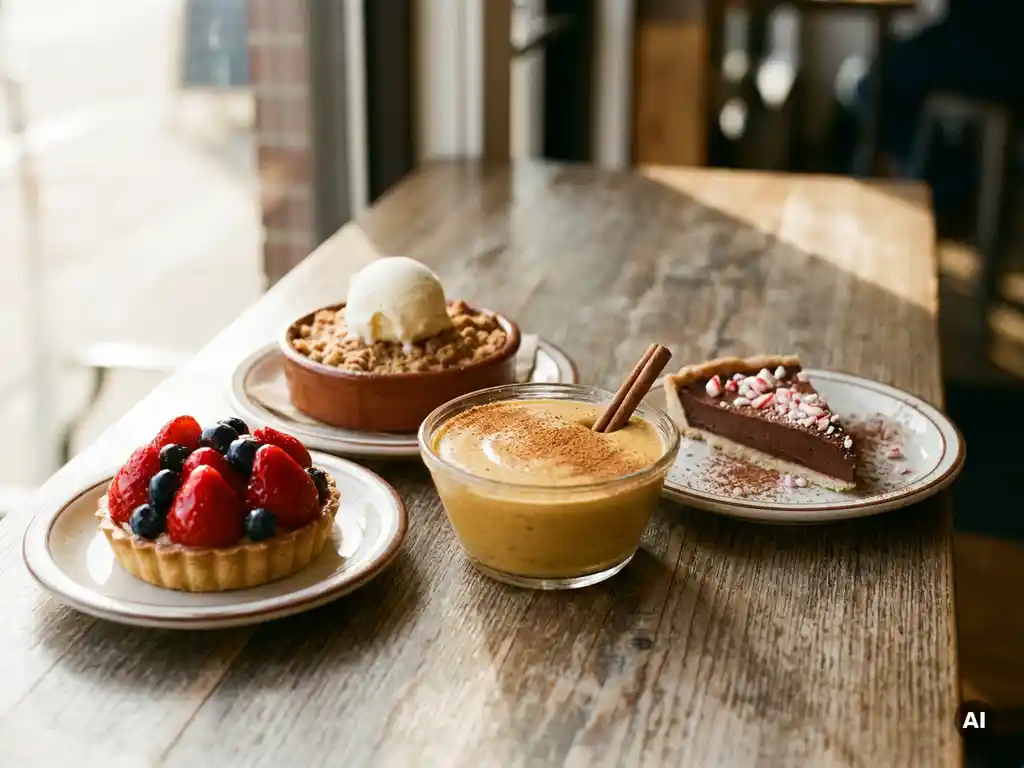
Seasonal café desserts change throughout the year by rotating ingredients, flavors, and menu items to match what’s fresh, culturally relevant, and in demand each season. Spring brings lighter, fruit-forward options; summer leans into chilled and refreshing treats; autumn introduces warm spices and harvest flavors; and winter centers on rich, indulgent comfort desserts. This cycle keeps menus exciting and connects customers to the rhythms of the year.
For specialty coffee enthusiasts, seasonal dessert menus matter beyond novelty: the right dessert can elevate a carefully brewed cup the same way a well-chosen wine pairing transforms a meal. The questions below unpack exactly how and why café dessert menus shift with the seasons, and what to expect at every turn of the calendar.
What ingredients drive seasonal café dessert menus?
Seasonal café desserts are primarily driven by ingredient availability, flavor relevance, and customer expectation. Pastry teams build their menus around what’s fresh and at peak quality in a given season: stone fruits in summer, root vegetables and apples in autumn, citrus in winter, and berries and florals in spring. Availability directly shapes both quality and cost, making seasonal sourcing as much a practical as a creative decision.
Beyond raw ingredient availability, cultural and calendar cues play a major role. Pumpkin and cinnamon aren’t just autumn flavors by accident: they’re tied to harvest traditions, holidays, and the sensory associations people build over a lifetime. Cafés lean into these associations deliberately because they trigger emotional resonance and drive repeat visits. A well-timed chai-spiced brownie in October will outsell a generic chocolate chip cookie simply because it feels right for the moment.
Specialty coffee shops in particular pay close attention to how dessert ingredients interact with their coffee offerings. A light, floral Ethiopian single-origin on the menu in spring might inspire a lavender shortbread or a lemon tart on the pastry shelf, not by coincidence, but by design.
How do café dessert menus typically change each season?
Café dessert menus typically change each season through a combination of full item swaps, limited-time additions, and ingredient substitutions within existing recipes. Most cafés rotate 30 to 60 percent of their dessert offerings between seasons, keeping a core of year-round bestsellers while introducing new seasonal specials that reflect the time of year.
The pattern generally follows a recognizable arc across the four seasons:
- Spring: Lighter textures and brighter flavors take over: lemon bars, strawberry tarts, elderflower cakes, and matcha-based pastries.
- Summer: Chilled and refreshing desserts dominate: cold brew cheesecakes, fruit galettes, iced affogato-style treats, and no-bake options.
- Autumn: Warm, spiced, and harvest-driven items appear: pumpkin loaves, apple crumbles, brown butter cookies, and maple-glazed pastries.
- Winter: Rich, indulgent, and festive desserts lead the menu: peppermint brownies, spiced gingerbread, dark chocolate tarts, and eggnog-flavored bakes.
The transition between seasons isn’t always abrupt. Many cafés run a brief overlap period, introducing new items while retiring old ones gradually to manage inventory smoothly and give regulars a chance to enjoy one last slice of a seasonal favorite.
Why do coffee shops rotate desserts seasonally instead of keeping a fixed menu?
Coffee shops rotate desserts seasonally because doing so creates anticipation, reduces ingredient costs, maintains quality, and keeps the menu feeling fresh. A fixed menu eventually becomes invisible to regulars: customers stop noticing what’s on offer. Seasonal rotation gives people a reason to return and a reason to try something new.
From an operational standpoint, sourcing ingredients at peak season is almost always cheaper and produces better results than sourcing out of season. A strawberry tart made with June strawberries tastes noticeably better than one made with imported strawberries in January, and costs less to produce. That quality difference shows up in the final product and in customer satisfaction.
There’s also a psychological dimension. Scarcity and limited availability make seasonal items feel more valuable. When customers know a pumpkin spice scone is only available for eight weeks, they’re more likely to order it, and to tell a friend. This creates natural word-of-mouth momentum that a permanent menu item rarely generates. For specialty cafés, this kind of intentional curation signals that the shop cares about craft, not just convenience.
What are the most popular seasonal desserts at coffee shops?
The most popular seasonal desserts at coffee shops tend to be items with strong flavor associations tied to a specific time of year. Pumpkin-spiced baked goods in autumn, peppermint brownies and gingerbread in winter, lemon or berry tarts in spring, and cold or fruit-based desserts in summer consistently rank among the top-performing seasonal café specials across the industry.
Within those broad categories, a few specific items stand out as perennial crowd-pleasers:
- Autumn: Pumpkin loaf, apple cinnamon muffins, brown butter blondies
- Winter: Peppermint chocolate bark, spiced gingerbread, cranberry orange scones
- Spring: Lemon poppy seed cake, strawberry shortcake, lavender shortbread
- Summer: Peach galette, cold brew tiramisu, berry cheesecake bars
What makes these items popular isn’t just flavor: it’s the emotional familiarity they carry. Customers associate these tastes with specific memories, holidays, and feelings. A café that executes a classic seasonal dessert well earns trust and loyalty in a way that a clever but unfamiliar creation rarely does.
How do seasonal desserts pair with specialty coffee drinks?
Seasonal desserts pair with specialty coffee drinks by complementing or contrasting the flavor profiles in the cup. The general principle is the same as food and wine pairing: match intensity with intensity, and look for flavors that either echo or balance each other. A rich, dark winter espresso pairs beautifully with a bitter chocolate tart; a bright spring pour-over with stone fruit notes lifts a lemon tart without competing with it.
At Beanstop, this kind of intentional pairing is part of what makes a café visit more than just a caffeine stop. When the dessert and the drink are chosen with the same care, the combination becomes greater than the sum of its parts.
Some reliable seasonal pairing principles to keep in mind:
- Autumn spiced desserts pair well with medium roasts, flat whites, or cortados: the milk softens the spice and adds body.
- Winter chocolate desserts pair well with dark roast espresso or a mocha: intensity matches intensity.
- Spring citrus and floral desserts pair well with light roast pour-overs or Kenyan or Ethiopian single-origins: the acidity in both lifts the pairing.
- Summer fruit desserts pair well with cold brew or iced lattes: the sweetness of the fruit balances the natural bitterness of cold-extracted coffee.
Should cafés announce seasonal dessert changes in advance?
Yes, cafés should announce seasonal dessert changes in advance, ideally one to two weeks before a new item launches or an existing one retires. Early announcements build anticipation, drive traffic during the transition period, and give regulars a chance to say goodbye to a favorite item before it disappears from the menu.
From a marketing perspective, seasonal dessert announcements are among the highest-performing content types for coffee shops on social media. A well-photographed preview of an incoming autumn menu generates engagement that a standard product post rarely matches, because it carries a time-sensitive element that motivates action.
There are two moments worth announcing specifically:
- The launch: Announce new seasonal items with enough lead time to generate excitement but close enough to the actual date to feel immediate. One to two weeks is the sweet spot for most café audiences.
- The farewell: Announce when a popular seasonal item is leaving soon. “Last week to get our pumpkin scone” posts consistently outperform standard promotional content because they create urgency without requiring a discount.
For cafés that invest in a seasonal dessert menu, the announcement strategy is just as important as the menu itself. A beautifully crafted seasonal special that no one knows about is a missed opportunity, both for the business and for the customers who would have loved it.